
TopStocks Alert: (NASDAQ: ONCY) Why Oncolytics Biotech Inc. Has Landed On Our Radar And The 7 Catalysts Behind It
Hello Readers,
A clinical-stage immunotherapy company (ONCY) just released data that most of the market hasn't properly priced in yet, and the setup is getting harder to ignore.
The company's lead asset, pelareorep, is showing 2-3x improvements over standard-of-care benchmarks in multiple difficult-to-treat gastrointestinal cancers, including data that would support accelerated approval pathways in the near term. Add a Type C FDA meeting already completed, a validated mechanism that works across multiple cancer types, and a development strategy narrowing toward the highest-probability indications, and you'll see exactly why this profile has climbed to the top of my watchlist.
If you're looking for a clinical-stage biotech with compelling efficacy data, near-term regulatory catalysts, and exposure to three substantial cancer markets, this one demands immediate attention:
Oncolytics Biotech Inc. (Nasdaq: ONCY)
Company Overview: Oncolytics Biotech Inc. (Nasdaq: ONCY)
Oncolytics Biotech is a clinical-stage immunotherapy company developing pelareorep, an investigational cancer treatment that works by replicating inside tumor cells with a specific genetic mutation (RAS), while converting "cold" (hard-to-attack) tumors into "hot" (easy-to-attack) tumors that the immune system can recognize and kill.
The company recently completed a change in jurisdiction of incorporation to Nevada and relocated its headquarters to San Diego, positioning itself for more efficient capital markets access. Management has been strengthened with the addition of experienced executives in strategy, operations, and biostatistics.
Pelareorep is being advanced in combination with standard chemotherapy across three gastrointestinal cancer types where very few treatment options currently exist and patient populations are large.
Company Overview Video
Here are the key catalysts coming into focus:
- Second-line metastatic colorectal cancer data showing 2-3x improvements over standard of care
- A Type C FDA meeting completed on a potential single-arm pivotal study in anal cancer
- Fast Track designations from the FDA for colorectal and pancreatic cancer
- Consistent survival benefits demonstrated in first-line pancreatic cancer across multiple studies
- A fully funded pipeline across three major gastrointestinal cancer indications
- A validated mechanism of action backed by >1,200 patients treated across 20+ studies
- A strategic development path targeting accelerated approval timelines in high unmet-need indications
Pelareorep Mechanism of Action: Converting "Cold" Tumors to "Hot" Tumors
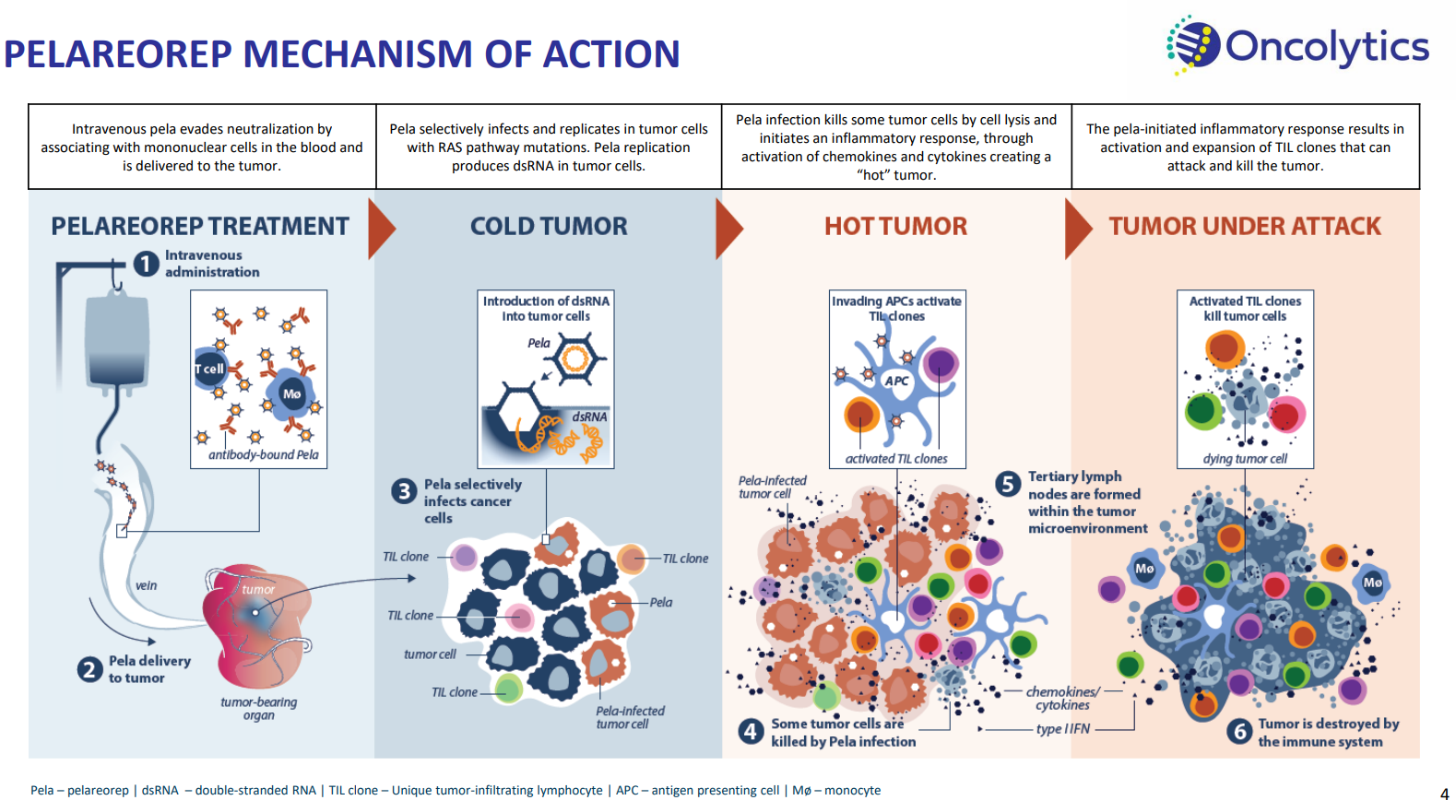
Source: Oncolytics Biotech June 2026 Investor Deck - How Pelareorep Works
Here's the simple version: Pelareorep is a virus (non-genetically modified) that only attacks cancer cells with a specific genetic mutation (RAS), while leaving healthy cells alone. When it replicates inside tumor cells, it triggers an immune response that wakes up the body's immune system to attack the cancer.
This is powerful because most cancers are "cold" — meaning the immune system doesn't recognize them as dangerous. Pelareorep converts these "cold" tumors into "hot" ones that the immune system can see and attack.
The process:
- Pelareorep is injected into the bloodstream and finds its way to cancer tumors
- It enters cancer cells (specifically those with RAS mutations) and replicates inside them
- This replication triggers inflammation and sends danger signals to the immune system
- Immune cells recognize the tumor as dangerous and attack it
This mechanism has been validated in biopsies across multiple cancer types, with >1,200 patients treated over more than 10 years.
Why Pelareorep in Colorectal Cancer Could Be a Game Changer
On May 4, 2026, Oncolytics reported new data from its REO 022 study in patients with a specific type of advanced colorectal cancer that has already failed standard chemotherapy. This is a treatment-resistant patient population with very few good options. The results are dramatically stronger than historical benchmarks for this population.
Pelareorep-based combination therapy (pelareorep + FOLFIRI + bevacizumab) demonstrated:
- 19.5-month median duration of response versus historical benchmarks of approximately 4–6 months — a 3-4x improvement
- 33% objective response rate versus 6–11% for standard of care — a 3x improvement
- 27-month overall survival versus historical 11.2 months
- 16.6-month progression-free survival versus historical 5.7 months
These figures are not from a head-to-head randomized trial, so direct comparisons carry caveats. However, the magnitude of the durability signal—19.5 months versus 4-6 months—is unusual and noteworthy. The company is currently enrolling a randomized Phase 2 study and is actively engaging with the FDA on a potential accelerated approval pathway.
What This Means For Investors: In second-line RAS-mutant colorectal cancer, pelareorep combination therapy is showing efficacy that is 2-3 times higher than the current standard of care across multiple endpoints. The company has FDA Fast Track designation in this indication, which enables more frequent FDA meetings, rolling review of the NDA/BLA, and potential priority review. This is the kind of durability data that regulatory authorities take seriously, especially in a patient population with few effective options.
Anal Cancer: A Rare Disease Opportunity With a Clear Regulatory Path
On April 6, 2026, Oncolytics announced completion of a Type C FDA meeting (this means the company sat down with FDA regulators and got official alignment on the exact study design needed to potentially get the drug approved). This is a major de-risking event because the company now knows exactly what it needs to do to reach the finish line.
SCAC is a rare disease with approximately 54,000 cases globally and very few effective treatment options once patients fail initial therapy. Oncolytics' GOBLET Cohort 4 data in late-stage anal cancer patients showed:
- 30% of patients responded to the drug versus only 10-14% with current best options — a 2-3x improvement
- Patients who responded stayed in remission for 17 months on average (vs. 9.5 months with alternatives)
- Two patients had complete remission (cancer completely gone), with one still in remission after 28 months
The company is proposing a single-arm pivotal study enrolling approximately 60-70 patients, with objective response rate as the primary endpoint. This regulatory pathway—single-arm registration in a rare disease with few treatment options—is more efficient than traditional randomized designs and may support approval as early as 2028-2029.
SCAC represents a rare disease commercial opportunity ($1 billion TAM), but more importantly, it offers the fastest path to proof of concept for the pelareorep platform. A successful registration in SCAC would validate the mechanism and strengthen the company's negotiating position for partnership discussions in the larger colorectal and pancreatic cancer indications.
What This Means For Investors: Oncolytics has already engaged with the FDA and received alignment on a potential single-arm pivotal study design. This is a de-risked regulatory pathway. The efficacy data (30% ORR, 17-month median duration of response) already substantially exceed real-world comparators. If the company executes enrollment, a BLA filing could occur as early as 2028, with a potential approval decision in 2029. This rare disease opportunity also provides a near-term value inflection.
Pancreatic Cancer: A Larger Commercial Prize With Consistent Survival Benefit
First-line metastatic pancreatic cancer is one of the deadliest cancers — only 3% of patients survive 5 years with standard treatment. Oncolytics has reported consistently strong survival benefits across multiple independent studies — which is unusual and noteworthy.
Study 1: Pelareorep + standard gemcitabine chemotherapy
- 2-year survival: 24% vs. only 4% with gemcitabine alone — 6x improvement
- 1-year survival: 45% vs. 22%
Study 2: Pelareorep + different chemotherapy combination (randomized, controlled)
- 2-year survival: 20% vs. 6% in the control group
- 1-year survival: 34% vs. 28%
Study 3: Pelareorep + aggressive multi-drug chemotherapy + immunotherapy
- Response rate: 62% of patients responded vs. 23%with chemotherapy alone
- 1-year survival: 45% vs. 35%
These are not randomized head-to-head comparisons, and the magnitude of improvement must be interpreted with that caveat in mind. However, the consistency of the survival signal across multiple independent studies with different chemotherapy backbones is notable.
The company has received FDA Fast Track and Orphan Drug designations in pancreatic cancer and is actively pursuing strategic partnerships to advance a pivotal Phase 3 study. Data from additional cohorts in the ongoing REO 029 study are expected in the second half of 2026.
What This Means For Investors: First-line pancreatic cancer is a much larger commercial opportunity than anal or second-line colorectal cancer. A $250-300 million annual peak sales potential is realistic if efficacy holds up in a confirmatory randomized trial. However, this indication requires partnership to fund and execute, and the regulatory pathway is longer (likely 2027-2028 for a pivotal study, 2029-2031 for potential approval). The colorectal and anal cancer indications offer nearer-term catalysts.
Leadership Team: Experienced Immuno-Oncology and Business Development Expertise
See leadership photos below from June 2026 investor deck.
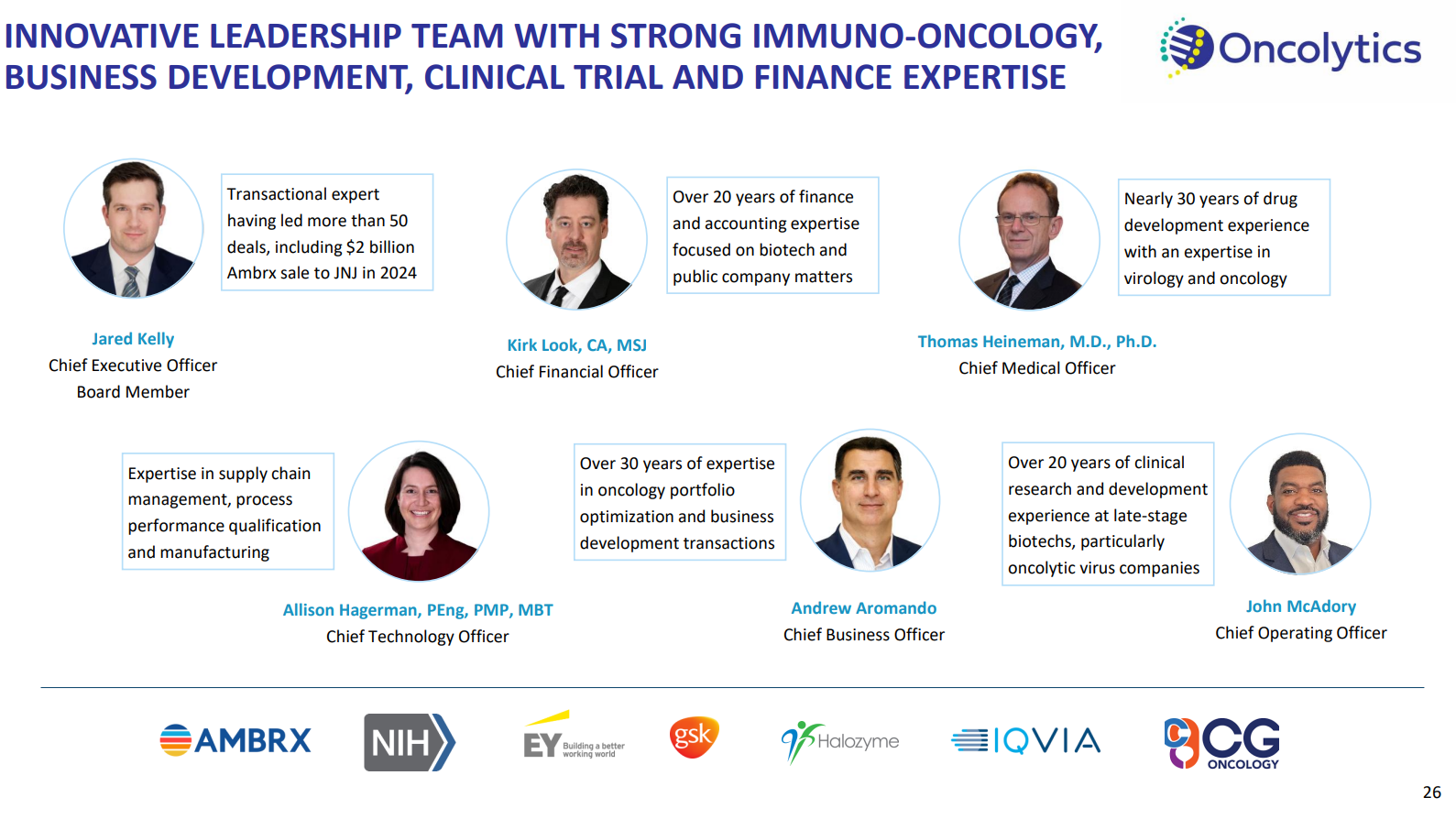
Source: Oncolytics Biotech June 2026 Investor Deck - Page 26
The company's leadership team brings substantial expertise in immuno-oncology, clinical development, business development, and financial management:
- Jared Kelly (CEO): Transactional expert having led more than 50 deals, including the $2 billion Ambrx sale to J&J in 2024
- Thomas Heineman, M.D., Ph.D. (Chief Medical Officer): Over 20 years of clinical research and development experience at late-stage biotechs, particularly oncolytic virus companies
- Kirk Look, CA, MSJ (Chief Financial Officer): Over 20 years of finance and accounting expertise focused on biotech and public company matters
- Allison Hagerman, PEng, PMP, MBT (Chief Technology Officer): Nearly 30 years of drug development experience with expertise in virology and oncology
- Andrew Aromando (Chief Business Officer): Over 30 years of expertise in oncology portfolio optimization and business development transactions
- John McAdory (Chief Operating Officer): Expertise in supply chain management, process performance qualification, and manufacturing
Seven Core Catalysts Driving Near-Term Value Creation
ONCY Catalyst #1: REO 022 Data in Second-Line Metastatic Colorectal Cancer
The May 4, 2026 data release showing 19.5-month median duration of response, 33% ORR, 27-month OS, and 16.6-month PFS represent the strongest clinical signal in the company's history. This data supports both the scientific rationale for the mechanism and the commercial potential. The company is actively enrolling a randomized Phase 2 study to confirm these findings and is engaging the FDA on accelerated approval opportunities.
ONCY Catalyst #2: Type C FDA Meeting Completion and Anal Cancer Single-Arm Pivotal Design
The April 2026 Type C meeting with the FDA resulted in alignment on a single-arm pivotal study design in SCAC. This is a regulatory de-risking event. The company can now move forward with defined parameters for enrollment, statistical analysis, and approval pathway. Study launch is expected in Q3 2026, with potential BLA filing as early as 2028.
ONCY Catalyst #3: FDA Fast Track Designations in Colorectal and Pancreatic Cancer
Fast Track status enables more frequent FDA meetings, rolling review of the NDA/BLA, and potential priority review. This accelerates timelines and reduces development risk. Both colorectal and pancreatic cancer programs carry this designation.
ONCY Catalyst #4: Pancreatic Cancer Data and REO 029 Cohort 5 Readouts
REO 029 Cohort 5 (pelareorep + modified FOLFIRINOX +/- atezolizumab) completed enrollment, with data expected in H2 2026. This cohort is particularly important because it uses the most aggressive chemotherapy backbone and may inform the design of the company's pivotal Phase 3 study. Partnership announcements could occur concurrently.
ONCY Catalyst #5: Strategic Partnership Announcements
The company is actively pursuing partnerships with major pharmaceutical companies to co-develop and co-commercialize pelareorep. A partnership in pancreatic cancer would be transformational, providing capital for a large pivotal study and commercial execution. Partnership announcements in colorectal or pancreatic cancer could be a major catalyst in the next 6-12 months.
ONCY Catalyst #6: Analyst Initiation and Price Target Updates
Zacks Small Cap Research initiated coverage on April 6, 2026 with a $6.00 price target(based on sample price of ~$0.80-1.10). The Zacks report specifically highlighted FDA alignment on anal cancer pivotal design, REO 022 colorectal efficacy, and Fast Track/Orphan Drug designations.
TradingView's consensus from 6 analysts shows an average 1-year price target of $5.02, with estimates ranging from $2.92 (conservative case) to $9.90 (bull case). The overall analyst rating is Strong Buy. This broad-based analyst interest aligns with the clinical data strength and regulatory momentum, suggesting major sell-side coverage could follow as the colorectal cancer durability data and anal cancer FDA pivotal design gain visibility. Full forecast: https://www.tradingview.com/symbols/NASDAQ-ONCY/forecast/
ONCY Catalyst #7: Manufacturing Scale-Up and Supply Chain Validation
Pelareorep is a non-genetically modified reovirus made in Carlsbad, California with a high-yield, low-cost manufacturing process. As development progresses toward potential registration, manufacturing scale-up and supply chain validation could become important milestones that de-risk commercial launch.
Market Opportunity: Three Large Gastrointestinal Cancer Indications
2L Metastatic Colorectal Cancer (mCRC)
- ~1,900,000 patients globally
- ~$20 billion total addressable market with 4.7% CAGR to 2033
- RAS-mutant patient population with high unmet medical need
- 15% mCRC 5-year survival rate
≥2L Unresectable Squamous Cell Anal Carcinoma (SCAC)
- ~54,000 patients globally
- ~$2.3 billion total addressable market by 2035 (7.7% CAGR 2025-2035)
- Evolving standard of care with very few treatment options
- 36% SCAC 5-year survival rate
1L Metastatic Pancreatic Ductal Adenocarcinoma (mPDAC)
- ~500,000 patients globally
- ~$3 billion total addressable market with 15% CAGR to 2032
- Chemotherapy standard of care with no approved immunotherapy
- 3% mPDAC 5-year survival rate
ONCY Recap: Seven Potential Catalysts
- REO 022 data in second-line metastatic colorectal cancer showing 2-3x improvements
- Type C FDA meeting completion and anal cancer pivotal design alignment
- FDA Fast Track designations in colorectal and pancreatic cancer
- Pancreatic cancer data from REO 029 Cohort 5 expected H2 2026
- Strategic partnership announcements for pelareorep development
- Analyst initiation and sell-side price target updates
- Manufacturing scale-up and supply chain validation
Coverage is now officially underway on Oncolytics Biotech Inc. (Nasdaq: ONCY). When updates become available, I will share them quickly. Talk soon.
Sincerely,
TopStocks.com