
TopStocks Alert: (NASDAQ: ZENA) Why ZenaTech Inc. Has Landed On Our Radar And The 10 Catalysts Behind It
Hello Readers,
ZenaTech Inc. (NASDAQ: ZENA) designs and manufactures its own AI-powered drones, runs a national Drone as a Service network, and owns a portfolio of enterprise software businesses, all under one roof.
NASDAQ: ZENA has moved to the top of our watchlist this week. Here's why.
Consider what landed in a single month:
- July 9: IQ Aqua underwater mine-detection drone entered active U.S. field testing in Florida
- July 14: Signed offers to acquire land survey and geospatial companies expected to add ~C$40 million in revenue
- July 21: First confirmed U.S. government defense agency demonstration now being scheduled
- July 23: Closed its 26th Drone as a Service acquisition
That pace of hardware progress, defense engagement, and acquisition-driven scale is why ZenaTech Inc. (NASDAQ: ZENA) has landed firmly on our watchlist.
ZenaTech Inc. (NASDAQ: ZENA | FSE: 49Q | BMV: ZENA)
ZenaTech is a technology company built on four pillars: AI-powered autonomous drones, Drone as a Service (DaaS), enterprise SaaS software, and an emerging quantum computing program.
The company operates over 47,000 square feet of manufacturing space across Taipei, Taiwan; Sharjah and Dubai, UAE; and Mesa, Arizona, plus an AI research division in Baton Rouge, Louisiana and new operations in Ukraine.
The strategy is vertically integrated: design and build the drone hardware, own the AI and software layer, then acquire legacy field-service businesses (land survey, inspection, power washing) and digitize their workflows with drones.
Leadership is Chairman and CEO Shaun Passley, Ph.D., CFO James Sherman, CPA, and CTO Sajjad Asif, P.Eng.
Why ZENA Is On Our Radar Right Now
- No. 1 — Revenue Grew 640% Year Over Year, The Fifth Straight Quarter Of Triple-Digit Growth.
- No. 2 — The DJI Ban Opened The Door ZenaTech Has Been Building Toward.
- No. 3 — The Flagship ZenaDrone 1000 Already Completed Paid Air Force And Navy Reserve Trials.
- No. 4 — The IQ Nano Just Got A New AI-Enabled Low-Light Camera System.
- No. 5 — The IQ Aqua Mine-Detection Drone Entered Active U.S. Field Testing.
- No. 6 — A Surveyor Shortage Is Creating The Demand ZenaTech Is Built To Absorb.
- No. 7 — New Signed Offers Could Add ~C$40M In Revenue.
- No. 8 — First Confirmed U.S. Defense Demonstration Now Being Scheduled.
- No. 9 — Three Drones Entered Cybersecurity Testing On The Green-To-Blue Pathway.
- No. 10 — Russell 3000 Addition And A Wide Valuation Gap Versus Drone Peers.
But more on those in a moment...
Company Breakdown — ZenaTech Inc. (NASDAQ: ZENA)
ZenaTech is not a one-product drone story. It spans hardware manufacturing, AI software, field services, and quantum computing research. That creates multiple paths to revenue instead of relying purely on drone sales.
And the revenue numbers have moved fast.
For fiscal 2025, ZenaTech reported revenue of CAD $12.9 million, up 558% year over year. The Drone segment alone contributed CAD $10 million in its first full year, or 78% of total revenue.
That growth accelerated into 2026. First quarter revenue hit CAD $8.4 million, up 640% from CAD $1.13 million a year earlier. DaaS drove 93% of it.
On June 30, the company reported a 2026 annualized revenue run rate of approximately CAD $33 million, which management called a baseline rather than a ceiling.
Important context on the losses: ZenaTech is not profitable and has been funding an aggressive build-out. It reported a CAD $45.2 million net loss in 2025, and Litchfield Hills models continued losses through 2027. The company held roughly C$15 million in cash against C$10.5 million in debt at the end of Q1 2026.
Market Opportunity:
ZenaTech frames its addressable market around a Drone as a Service industry projected to grow from $16.5 billion in 2025 to $355 billion by 2032, plus a global military drone market expected to reach $87.6 billion by 2030.
The ZenaDrone 1000 — The Flagship Platform
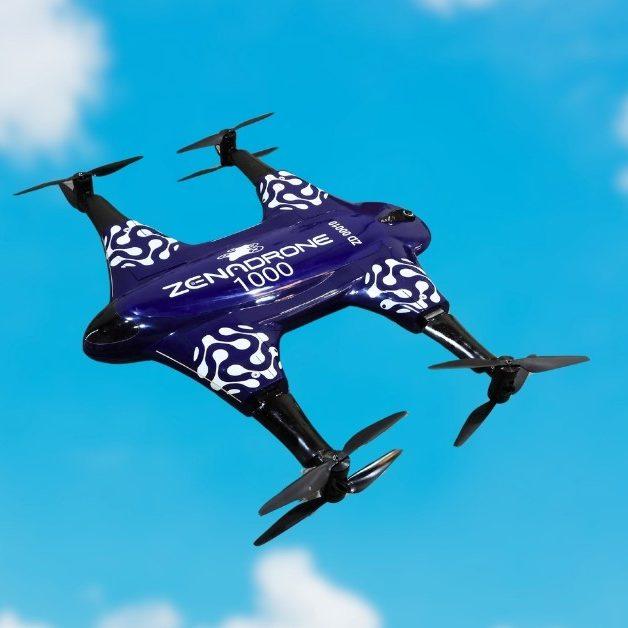
The ZenaDrone 1000 is a 12 x 7 foot VTOL platform with eight rotors and a 40-kilogram (roughly 88 lb) lift capacity, with about 60 minutes of flight time. Pricing runs $100,000 to $250,000 plus software.
It's built for:
- Defense — inspection, surveillance, reconnaissance, cargo, and border patrol
- Precision agriculture — sprayer attachments and multispectral scanners
- Heavy-lift logistics — moving critical supplies over difficult terrain
Key details that matter:
- Completed paid trials with the U.S. Air Force and U.S. Navy Reserve, including carrying critical medical cargo such as blood in the field
- Interchangeable sensor nose cone for mission-specific configurations
- Proprietary DroneNet communications system
- Foldable wings so the drone fits in the back of a truck
- Company materials also describe a gas-powered variant in development for multi-hour endurance
The ZenaDrone 1000 anchors a portfolio that now includes the IQ Square (outdoor inspection), IQ Quad (LiDAR mapping), IQ Nano (indoor), IQ Aqua (underwater), the ZenaDrone 2000 gas-powered maritime interceptor, the IQ Glider launch platform, and the expendable Interceptor P-1.
Watch ZenaTech's drone platforms in action
The 10 Catalysts Driving (NASDAQ: ZENA) To The Top Of Our Watchlist
No. 1 — Revenue Grew 640% Year Over Year, The Fifth Straight Quarter Of Triple-Digit Growth.
Plenty of small-caps talk about growth. ZenaTech is reporting it.
First quarter 2026 revenue came in at CAD $8.4 million, up 640% from CAD $1.13 million in the same quarter a year earlier.
That is not a one-quarter spike. It is the continuation of a pattern:
| Quarter | Revenue | YoY Growth |
|---|---|---|
| Q1 2025 | CAD $1.14M | +92% |
| Q2 2025 | CAD $2.24M | +504% |
| Q3 2025 | CAD $4.35M | +1,225% |
| Q4 2025 | CAD $5.19M | +671% |
| Q1 2026 | CAD $8.40M | +640% |
Full-year 2025 revenue reached CAD $12.9 million, up 558% from roughly CAD $2.0 million in 2024.
The engine is Drone as a Service, which drove 93% of first quarter 2026 revenue. On June 30, management annualized the quarter into a run rate of approximately CAD $33 million and called that figure "a baseline rather than a ceiling," noting that several acquisitions have not yet contributed a full twelve months of revenue.
Looking forward, Litchfield Hills Research forecasts revenue of CAD $39.0 million in 2026 and CAD $55.5 million in 2027.
Two things to keep in mind. First, this growth is acquisition-driven, not organic. ZenaTech is buying revenue and then working to improve it with drones, so the percentages reflect a much larger footprint rather than a surge at existing locations. Second, ZenaTech is not profitable, reporting a net loss of roughly CAD $45.2 million in 2025, and analyst models show growth decelerating to about 42% by 2027 as the base gets larger.
No. 2 — The DJI Ban Opened The Door ZenaTech Has Been Building Toward.
In December 2025, the FCC added DJI and other foreign-made drones and critical components to its Covered List, blocking new models from receiving FCC equipment authorization.
DJI had controlled close to 80% of the U.S. commercial drone market.
Existing DJI drones remain legal to fly. But new models are cut off, and separate federal rules under the American Security Drone Act bar covered foreign drones from federally funded contracts entirely.
Layered on top, the NDAA bars the Department of War from buying drones, components, or software from covered foreign entities, and the American Security Drone Act extends that restriction to civilian federal agencies and anyone spending federal grant money.
The practical effect is a bifurcated market: a shrinking untrusted segment, and a growing policy-protected government and infrastructure segment where NDAA-compliant suppliers can compete. ZenaTech has been building NDAA-compliant, American-made manufacturing capacity in Mesa, Arizona specifically to serve it.
Worth framing correctly: ZenaTech's platforms are support-mission systems for ISR, inspection, logistics, inventory, and base security. The company is not a vendor in the Pentagon's one-way attack drone programs, so the right yardstick is support-mission procurement, not weaponized drone budgets.
No. 3 — The ZenaDrone 1000 Already Completed Paid Air Force And Navy Reserve Trials.
The ZenaDrone 1000 proved out ZenaTech's defense and agriculture use cases and remains the company's highest-priced hardware product.
In a February 2025 filing with the SEC, the company disclosed that it "previously completed two paid trials with the US Air Force and the US Navy Reserve for logistics and transportation applications carrying critical cargo." ZenaTech has reiterated that record since, including in its December 2025 defense engagement update, which describes the cargo as temperature-controlled medical supplies.
Completed paid trials give ZenaTech a real track record to point to. That is a meaningfully different position than a company pitching from a prototype.
One note on sourcing: these trials are described in ZenaTech's own disclosures and SEC filings. We did not find a separately published Department of War contract award confirming them, so readers should treat the detail as company-reported.
No. 4 — The IQ Nano Just Got A New AI-Enabled Low-Light Camera System.
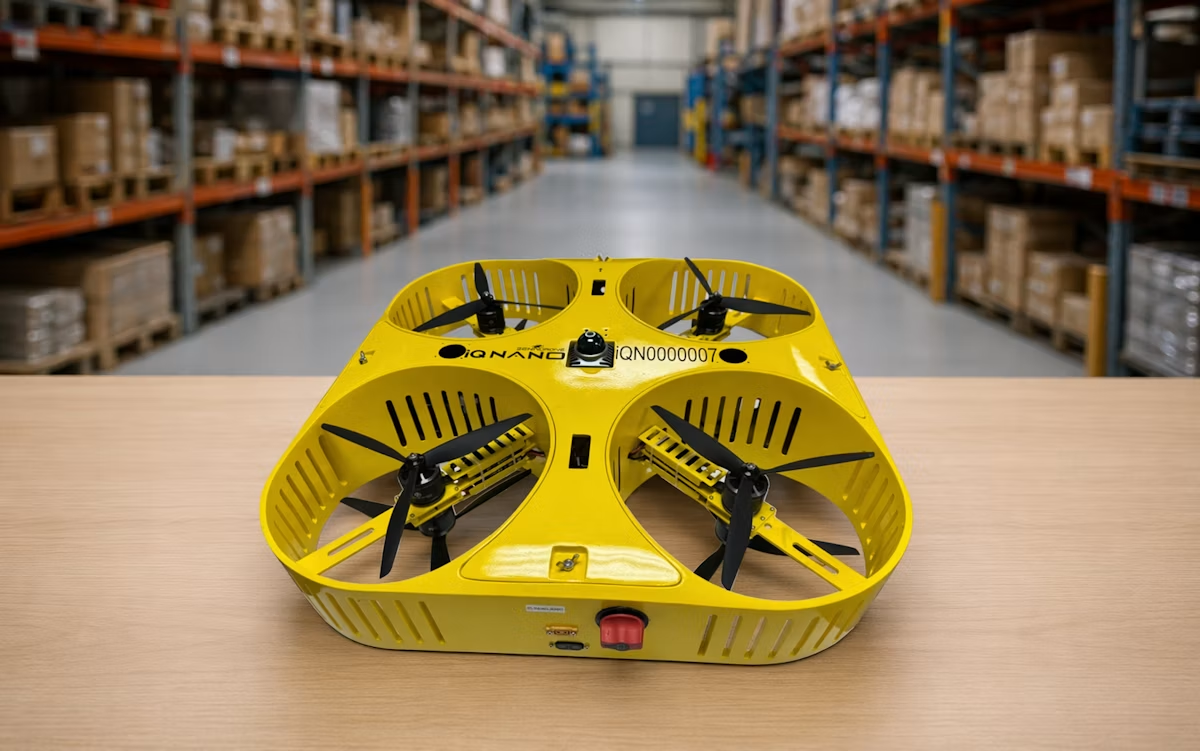
On June 25, 2026, ZenaTech announced a new AI-enabled camera system with integrated LED lighting for its IQ Nano indoor drone.
It's designed and manufactured in-house by ZenaTech's Spider Vision Sensors subsidiary in Taiwan, which supplies cameras, sensors, motors, and PCBs through an NDAA-compliant supply chain.
The system targets low-light performance for inventory management, security, inspection, and defense logistics. First prototypes are being evaluated at ZenaDrone's Sharjah, UAE facility, with 20 to 30 additional units in production.
Why this one matters: the IQ Nano is also the drone ZenaTech is leading with in its first government defense demonstration, and it's paired with warehouse management software the company already owns through its InterlinkONE acquisition.
No. 5 — The IQ Aqua Mine-Detection Drone Entered Active U.S. Field Testing.

On July 9, 2026, ZenaDrone moved the IQ Aqua autonomous underwater vehicle into active field testing near Pensacola, Florida, a major step since the prototype debuted in March 2026.
Testing spans controlled aquatic environments and open water, validating stability, maneuverability, sensors, and autonomous navigation ahead of a faster Version 2 platform.
IQ Aqua is designed for:
- Undersea mine detection and mine-countermeasure support
- Covert underwater ISR
- Port and harbor threat detection
Management is targeting U.S. defense customers, NATO partners, and U.S.-allied Gulf nations in a global underwater drone market projected to exceed $16 billion by 2034.
No. 6 — A Surveyor Shortage Is Creating The Demand ZenaTech Is Built To Absorb.
This is the piece most people miss, and it's the reason the whole roll-up strategy makes sense.
According to the National Society of Professional Surveyors, the average age of a Licensed Professional Surveyor in the U.S. was 60 years old in 2025. There are roughly 40,000 licensed surveyors nationally, and they are not being replaced.
Only 483 people passed the final national licensing exam in 2024. That is less than half the replacement rate. On current trends, Litchfield Hills projects the number of licensed surveyors could be cut in half by 2050.
Traditional surveying firms are limited by how many licensed technicians they employ and how many field hours those people can work. Drone-enabled workflows break that ceiling by letting one operator run multiple data-capture missions while automated processing handles the deliverables.
That is the entire thesis: revenue that no longer scales with headcount.
No. 7 — New Signed Offers Could Add ~C$40M In Revenue.
On July 14, 2026, ZenaTech signed offers to acquire multiple land surveying and geospatial services companies across the U.S., Canada, and Australia.
Subject to closing, management expects these businesses to collectively contribute approximately C$40 million in revenue during the first 12 months after closing.
Two caveats worth stating plainly: that estimate is based on unaudited information from the target companies plus management projections and has not been verified by auditors. Each deal remains subject to due diligence and definitive agreements, so closing is not guaranteed.
This builds on a roll-up that has already produced 26 completed DaaS acquisitions, most recently the July 23 close of Dayton, Ohio-based BA Land Professionals, which extended the U.S. footprint to 12 states. Counting software and IP deals alongside DaaS, Litchfield Hills tallied 36 acquisitions announced and 32 closed as of its June 2026 report.
No. 8 — First Confirmed U.S. Defense Demonstration Now Being Scheduled.
On July 21, 2026, ZenaTech announced that ZenaDrone is scheduling technology demonstrations with U.S. government defense agencies, starting with its first confirmed agency engagement, leading with the IQ Nano.
CEO Shaun Passley framed it as moving ZenaDrone's technology out of the lab and test range and into the hands of the people who will use it.
After a year of engagement with Defense Agency Program Managers and Members of Congress, this is the first concrete checkpoint in converting groundwork into an actual program relationship.
No. 9 — Three Drones Entered Cybersecurity Testing On The Green-To-Blue Pathway.
This is the most tangible defense milestone in the story.
In May 2026, ZenaTech disclosed that all three target platforms — the ZenaDrone 1000, IQ Square, and IQ Nano — completed the first two phases of the accelerated Green-to-Blue process and entered cybersecurity validation, including penetration testing for system resilience and encryption integrity.
That matters for a specific reason: it is the first time all three drones have moved through advanced certification simultaneously. Earlier efforts were one platform at a time. If testing succeeds, ZenaTech could approach agencies with multiple approved systems at once rather than a single drone.
Blue UAS is the Department of War's cleared list and the effective gold standard for federal drone procurement. Clearing it lets agencies buy without case-by-case waivers.
The company has also opened a Washington, D.C.-area office, established the Zena AI R&D division in Baton Rouge, and is advancing Eagle Eye, which pairs AI drones with quantum computing for predictive defense intelligence, plus a 5-qubit quantum prototype targeted for later in 2026.
To be clear: certification is in progress, not complete. Cybersecurity testing is followed by Defense Contract Management Agency review. This remains the single biggest gate to watch.
No. 10 — Russell 3000 Addition And A Wide Valuation Gap Versus Drone Peers.
ZenaTech was added to the Russell 3000 Index effective June 29, 2026, while keeping its Russell Microcap membership. Roughly $12.2 trillion in assets are benchmarked against the Russell US indexes.
On the analyst side, Litchfield Hills Research initiated coverage on June 8, 2026 with a Buy rating and a $4 price target, and Maxim Group maintains a Buy with a $5 target. You can track current analyst estimates on the ZENA forecast page at TipRanks.
The valuation argument in the Litchfield Hills report is straightforward. Analyst Barry M. Sine forecasts revenue of C$39.0 million in 2026 rising to C$55.5 million in 2027. Against a group of ten publicly traded drone comps trading at an average of 8.5x EV/2027 estimated revenue, ZenaTech trades near 2.9x. Palladyne AI, which Sine calls the closest software-and-AI-heavy comparable, trades around 10.3x.
Two things to keep in mind. Price targets reflect individual analysts' models and are not guarantees. And per its own disclosures, Litchfield Hills Research has received compensation from ZenaTech for distribution and investor targeting services, which readers should weigh when considering its conclusions.
(NASDAQ: ZENA) Recap — 10 Catalysts
- No. 1 — Q1 2026 revenue up 640% YoY to CAD $8.4M, a fifth straight quarter of triple-digit growth.
- No. 2 — The FCC's DJI ban removes the manufacturer that held ~80% of the U.S. drone market from new sales.
- No. 3 — Flagship ZenaDrone 1000 completed two paid Air Force and Navy Reserve trials (company-reported).
- No. 4 — IQ Nano gains an AI-enabled low-light camera from Spider Vision Sensors.
- No. 5 — IQ Aqua mine-detection drone enters active field testing in Florida.
- No. 6 — A surveyor shortage (average age 60, only 483 new licenses in 2024) drives structural demand.
- No. 7 — New signed offers could add ~C$40M in revenue, on top of 26 completed DaaS acquisitions.
- No. 8 — First confirmed U.S. defense demonstration now being scheduled.
- No. 9 — Three drones in cybersecurity testing on the Green-to-Blue pathway.
- No. 10 — Russell 3000 addition and a 2.9x vs 8.5x valuation gap versus drone peers.
ZenaTech Inc. (NASDAQ: ZENA) has landed on our radar in a big way. We are watching closely. Updates to follow.
Sincerely,
TopStocks.com